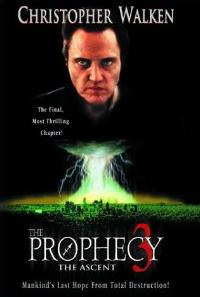
 Three years after “The Prophecy 2” pushed the angelic war to the brink, the series is brought full circle with this intended final chapter, “The Prophecy 3: The Ascent” directed by Wes Craven’s go-to film editor, Patrick Lussier (“My Bloody Valentine”).
“The Prophecy 3: The Ascent” begins approximately 15 years after the events of the previous film. With the birth of the Nephilim, the rebel angels, led by a brutal angel known as Pyriel, are more desperate than ever before and will tear apart Heaven and Earth to achieve victory. To stop Pyriel and his right-hand man Zophael (Vincent Spano), Gabriel (Christopher Walken) must help Danyael, the Nephilim, to realize his true destiny and confront Pyriel in one final battle with the fate of humanity hanging in the balance.
Written by Joel Soisson (“Highlander: Endgame”) and Carl Dupre (“Detroit Rock City”), this third installment tells a story of destiny and redemption, wrapped up in a thrilling cat-and-mouse game between the angels and the Nephilim. As with any trilogy, the second installment typically strikes a darker tone and raises the stakes for all involved. So after the uncertain and surprising nature of the concluding moments from the second film, it was only natural that like any good trilogy, the final chapter would attempt to take the series into a better place.
This series has always been one steeped heavily in religion (whether accurately depicted or not), namely Christianity and/or Catholicism, where themes such as free will, the importance of a soul, and faith have played such a pivotal role. So, it only seemed natural that the concepts of destiny and redemption would eventually come into play.
Destiny plays the most pivotal part in the film, as it serves as the cornerstone for the primary storyline for Danyael, the Nephilim (a being born of an angel and a human woman). At first I found the decision by the writers to have Danyael’s story be the primary to be an odd choice, given that Christopher Walken’s character of Gabriel had essentially become the focus in the previous entry. Not to mention he has been one of the few cast members to remain onboard the series since the beginning. However, after seeing the movie, I have to say that the choice to place Danyael front-and-center was appropriate, given that without more insight into his character the film would have just fallen apart.
What I liked about how the writers handled Danyael, and his destiny to become mankind’s last hope against the rebel angelic forces, was his struggle to accept this fate and believe it to be true. This take on destiny gave me yet another surprise from this series in how reverent it has been on matters such as this. Because, I know there have been times in my own life where I’ve wondered how important I really am in the grand scheme of things? What difference could I possibly make in God’s plans?
I found it interesting that Danyael was conflicted over his role in the war and whether he even wanted to accept his destiny. Plus, wondering why would God even choose him of all people for such a task? It’s these types of questions (not about our role in an angelic war, obviously) that we, or at least I, struggle with throughout life, and ultimately you just have to have faith and go for it.
As for the redemption aspect to the story, as many of you have no doubt determined by now, it is the focus for Gabriel’s arc. After all the dark acts he has committed in the previous two films, and being made human at the end of “The Prophecy 2”, it makes sense that Gabriel would reevaluate some of his views on humanity. With Gabriel’s storyline, I was pleased by the fact that the writers didn’t make his redemption into some schmaltzy, cheese-filled farcical character motivation. For that approach would have been insulting to the audience, the character, and to the concept itself. Thankfully, his redemption was handled with respect, making both the character and the movie all the better for it.
Headlining the cast for this film, despite not being the main character, is none other than the ever-reliable Christopher Walken. This time around Christopher was allowed to explore an entirely new version of Gabriel, as a human being trying to atone for past mistakes and right the wrongs he has perpetrated in the name of his misguided war. There was an obvious care-free spirit that Chris brought to the role, an aspect of the character that he seemed to enjoy portraying for a change. Gabriel’s new outlook on humanity and his conviction to finally do what is right was genuinely conveyed by Christopher and seemed a natural progression for the character.
Portraying Danyael is relative unknown actor Dave Buzzotta (“Children of the Corn 5: Fields of Terror”). Considering much of Dave’s film experience has been in low-budget, Direct-to-DVD horror sequels, I was surprised by his fairly capable performance. For the most part, Dave handled all of the inner-conflicts of Danyael and his eventual discovery of his grand destiny in a believable manner. There were moments throughout his performance where Dave could have easily made his character annoying with the bouts of complaining and whining about his lot in life and general disbelief in all things God or destiny related. Yet, he always managed to rein it in just before he reached that point, which is something not all actors, both veteran and newbie, know how to steer away from.
Rounding out the cast is actor Vincent Spano (“Texas Rangers”) as the angel Pyriel’s right hand man (so to speak), Zophael. For his portrayal, Vincent mixes in all of the darkness from Christopher Walken’s earlier performances as Gabriel, along with even more energy and athleticism, giving us a deadly new angel that made Gabriel seem like a walk in the park. On the flip side, where Vincent’s portrayal was more violent and evil in nature, he lacked the charisma and off-beat sense of humor that made Christopher’s Gabriel enjoyable to watch, in a slightly twisted sort of way.
It’s too bad that one couldn’t help but make the comparison between Zophael and Gabriel. After all, Vincent’s performance was solid on its own merits, he just had too good of a lead-in to contend with.
Lastly, I’m sure that one or two of you may be wondering what about this new leader of the rebel angels? What about Pyriel? Well, the problem is, there’s not much to say about actor Scott Cleverdon’s performance as Pyriel, because it really didn’t amount to much. He’s given one or two lines, and other than that he basically appears a handful of times, looking creepily straight into the camera. It’s kind of an unsettling look he gives, so in terms of conveying a creepy villainous character Scott did a good job, but otherwise he didn’t really do much of anything worth talking about.
To be honest, the Pyriel character was the biggest drawback for this movie. I hate it when a character is built up so much either throughout the course of a movie or in some cases in the advertising for said movie. For this film it’s a case of the former. Pyriel was touted as being the baddest of the bad in regards to the rebellious angels. Yet, we never really get a sense of that beyond some freaky sort of staring contest Scott is apparently having with the camera. More should have been done with this character, and the movie would have been even better for it.
Overall, this third entry in the series features an interesting story of destiny and repentance, entertaining action sequences, and good performances (for the most part). “The Prophecy 3: The Ascent” brings the saga to a close in a very satisfying manner. I would be remiss not to mention that this entry should have been, and arguably was intended to be the final installment; however, two more sequels were released. That being said, neither of the following sequels were all that enjoyable or had much to do with their predecessors. As it stands, one could easily view this film as the final chapter in the initial trilogy of the series and be completely pleased with the outcome.
“The Prophecy 3: The Ascent” is rated R for violence, language, and brief nudity.